
Exploring New and Expansive Hyperloop Technologies
HYPED’s research team is one of the three main pillars of the society and pushes forward into areas the technical team have yet to explore. Every year, the research team delves into the many aspects of Hyperloop technology with intent to improve its implementation and bring it a step closer to reality.
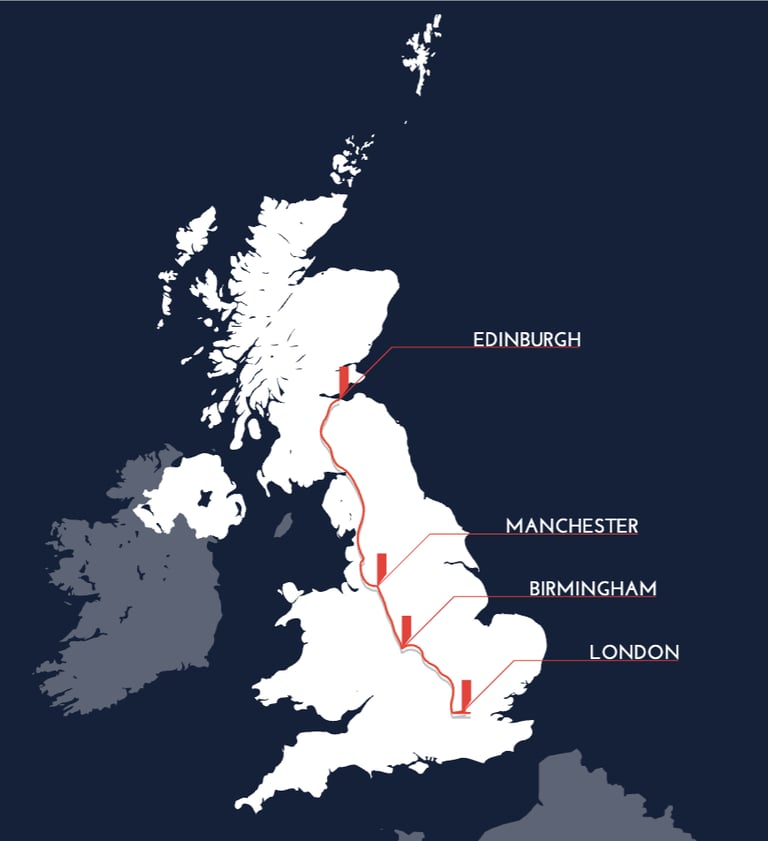
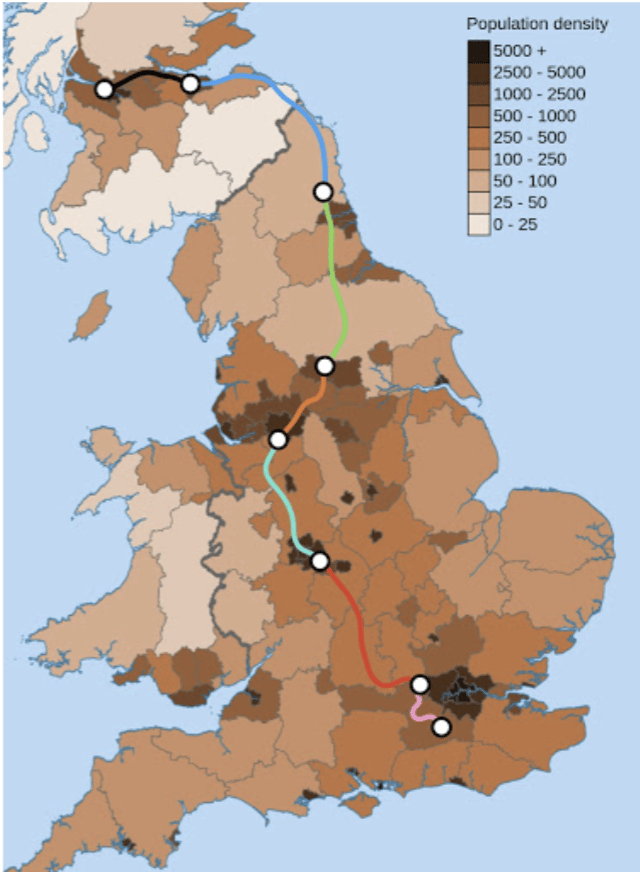
HYPED are winners of the Virgin Hyperloop One Global Challenge in 2017, having proposed a route connecting Edinburgh to London in 50 minutes. Our proposal discussed the feasibility of Hyperloop in the UK, highlighting the social, economic and environmental impacts. Out of 2600 entries, HYPED is one of ten winners across the globe and the only student team to have won the Global Challenge.
Since 2021, we have been publishing and presenting our paper at European Hyperloop Week (EHW), where it is shared and competes with publications from other Hyperloop teams. HYPED has proven to provide great contributions in the research side of the Hyperloop community as we were selected as the top 4 finalists for the full-scale research category in EHW 2023.

A Comparative Analysis of Inductive Coil Architectures for Wireless Power Transfer Under Misalignment Conditions
2026
Hyperloop Pod Design and Vacuum Optimisation
2024
Optimisation of Hyperloop Pod Run Operations for Enhanced Passenger Safety and Sustainability
2025
The UK Spine; A Regenerative Project for the United Kingdom
2017
Observing The Complexity Of A Hyperloop: Beyond The Sphere Of A Technical Marvel
Investigation into the feasibility of introducing Hyperloop to the UK Contents
Feasibility Study of Suspension and Levitation Systems for a Hyperloop System
Integration and Performance Study of Vacuum Pumps and Airlocks in a Hyperloop System
2023
2019
2022
2021

2026 - A Comparative Analysis of Inductive Coil Architectures for Wireless Power Transfer Under Misalignment Conditions
Wireless Power Transfer (WPT) is a promising technology for supplying energy to high-speed transportation systems such as Hyperloop, where contactless power delivery can reduce mechanical wear, maintenance demands, and operational downtime. However, inductive WPT efficiency is highly sensitive to spatial misalignment between transmitter and receiver coils, making coil geometry a critical design consideration for reliable large-scale deployment. In resonant inductive systems, the coupling coefficient directly governs the achievable power transfer efficiency, making it a key metric for evaluating coil performance.
This paper presents a comparative analysis of three planar coil architectures: spiral, hexagonal, and double-D (DD), assessing their suitability for Hyperloop-scale WPT applications under realistic misalignment conditions. To ensure a fair comparison, all coil designs are standardised using consistent geometric and electrical parameters. The self-inductance and mutual inductance of each configuration were analytically derived using electromagnetic formulations, enabling an initial evaluation of coupling behaviour under vertical and horizontal misalignments. Subsequently, finite-element simulations were performed in SimScale to validate the analytical models, providing a more rigorous basis for investigating variations in coupling coefficient across misalignment scenarios relevant to Hyperloop operation.


2025 - On the Optimisation of Hyperloop Pod Run Operations for Enhanced Passenger Safety and Sustainability
The paper aims to explore recommendations in which the energy is modelled and can be quantitatively reduced through improvements of the current subsystem of propulsion. Further, an original design based on a flywheel energy storage system will be presented, adapting the principles from other forms of transport. In particular, a basic control system will be put forward for the regenerative braking design. To gather data for analysis of hyperloop propulsion equations, literature review was conducted using academic databases, including Google Scholar, Research Rabbit, and DiscoverEd (University of Edinburgh’s search tool). My focus was on extracting key parameters such as, pod speed, pod mass, acceleration time to target speed, thermal losses and propulsion efficiency.
Finally, a thorough design of the emergency system will be presented, thereby investigating the enhancement of passenger safety in the event of unforeseen circumstances irregular to the typical pod run and predictive, preventative measures that can be taken to reduce the risk of emergencies occurring


2023 - Integration and Performance Study of Vacuum Pumps and Airlocks in a Hyperloop System
Historically, the United Kingdom has been at the forefront of technological innovation in transportation, from pioneering railways to the world's first underground system. Hyperloop technology offers promise in bridging economic disparities across Britain. Past transport advancements, like the canal system, fuelled industrial growth and reduced inequalities. Moreover, new trading opportunities spread wealth to communities in proximity to these routes and promoted growth in the local economies.
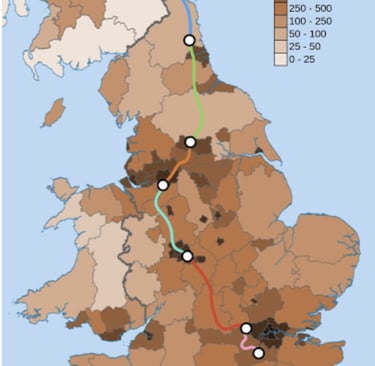
However, recent reliance on strained conventional rail and air networks has faced consequences such as provoking passenger distress and a loss of competitive advantage. The proposed UK Spine, a Hyperloop route going through Edinburgh - Manchester - Birmingham - London, aims to bolster sustainability pillars - economic, social, and environmental, by revitalising transport infrastructure. Amid challenges like post-Brexit uncertainties, the government plans to mitigate risks through increased investment in innovative technology research and skill development to drive economic growth and address social inequalities.
2022 - Feasibility Study of Suspension and Levitation Systems for a Hyperloop System
This paper explores the feasibility of four suspension/levitation systems for Hyperloop: wheel-on-rail suspension (WRS), electrodynamic suspension (EDS), electromagnetic suspension (EMS), and electrodynamic wheels (EDW). Each system is analysed in terms of its different technologies, costs, and commercialization potential. While EDW is seen as potentially the cheapest maglev option, it lacks the relevant implementation data needed to compare with the other potential systems. EMS offers dynamic but unstable force, contrasting with EDS's stability, however, EDS requires a minimum speed for lift while EMS does not. EDW provides lift and thrust at all speeds but possesses a complex configuration. WRS, despite not eliminating wheel-on-track friction, is highly commercialised.
In the end, a conclusive comparison could not be done as there was insufficient data. However, this paper highlights the fact that the limitations of some systems were overcome by others. Due to a lack of information on certain systems, further research will be necessary for a more definitive assessment.


2021 - Investigation into the feasibility of introducing Hyperloop to the UK Contents
Historically, the United Kingdom has been at the forefront of technological innovation in transportation, from pioneering railways to the world's first underground system. Hyperloop technology offers promise in bridging economic disparities across Britain. Past transport advancements, like the canal system, fuelled industrial growth and reduced inequalities. Moreover, new trading opportunities spread wealth to communities in proximity to these routes and promoted growth in the local economies.
However, recent reliance on strained conventional rail and air networks has faced consequences such as provoking passenger distress and a loss of competitive advantage.. The proposed UK Spine, a Hyperloop route going through Edinburgh - Manchester - Birmingham - London, aims to bolster sustainability pillars - economic, social, and environmental, by revitalising transport infrastructure. Amid challenges like post-Brexit uncertainties, the government plans to mitigate risks through increased investment in innovative technology research and skill development to drive economic growth and address social inequalities.
2019 - Observing The Complexity Of A Hyperloop: Beyond The Sphere Of A Technical Marvel
Large-scale infrastructure projects, such as the Channel Tunnel, provide extensive benefits, simultaneously pose significant challenges, including disruptions and cost overruns. The Hyperloop, a novel technology, likely anticipates similar challenges that demand innovative solutions. Issues such as project cost and sustainability are prominent, with cost-effectiveness essential for consumers to willingly switch away from traditional transport methods.
Additionally, the potential for cargo transport remains unexplored. Overall, integrating Hyperloop into an ageing public transport system necessitates addressing safety and reliability concerns. Understanding these complexities is important for implementing the technology effectively, ensuring it provides secure and efficient mobility for both people and freight.

2017 - The UK Spine; A Regenerative Project for the United Kingdom
Historically, the United Kingdom has been at the forefront of technological innovation in transportation, from pioneering railways to the world's first underground system. Hyperloop technology offers promise in bridging economic disparities across Britain. Past transport advancements, like the canal system, fuelled industrial growth and reduced inequalities. Moreover, new trading opportunities spread wealth to communities in proximity to these routes and promoted growth in the local economies.
However, recent reliance on strained conventional rail and air networks has faced consequences such as provoking passenger distress and a loss of competitive advantage.. The proposed UK Spine, a Hyperloop route going through Edinburgh - Manchester - Birmingham - London, aims to bolster sustainability pillars - economic, social, and environmental, by revitalising transport infrastructure. Amid challenges like post-Brexit uncertainties, the government plans to mitigate risks through increased investment in innovative technology research and skill development to drive economic growth and address social inequalities.